
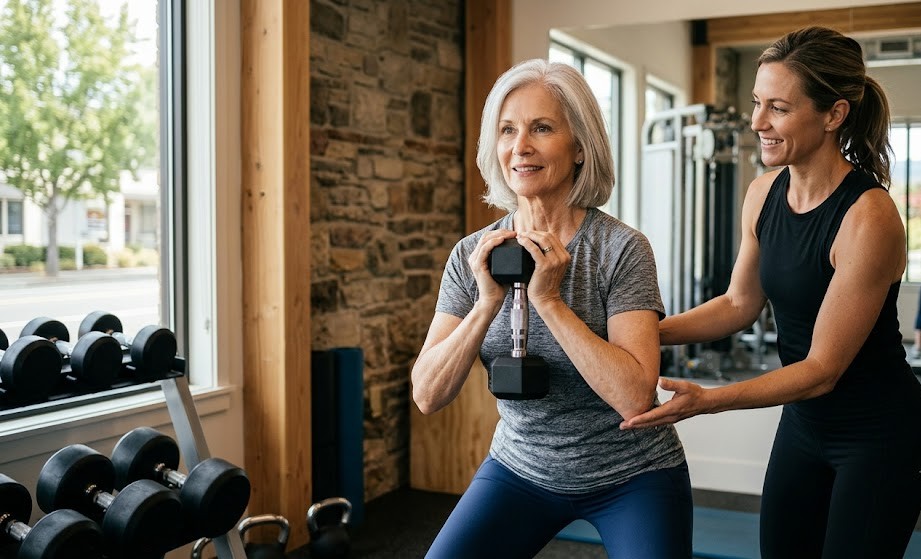
Muscle loss is quiet. It doesn't announce itself with a dramatic event – it shows up gradually, in the things that used to feel easy. The stairs that wind you now. The grocery bags feel heavier than they should. The moment you realize you grabbed a railing you didn't use to need.
At Studio Fitness in Santa Rosa, we work with adults every day who are dealing with exactly this – and the good news is that most of what they're experiencing is reversible. A well-designed strength training program doesn't just slow the decline; it actively rebuilds capacity, stability, and confidence in ways that change how you move through daily life.
This article covers what muscle loss actually costs you after 50, what keeping it gives you back, and what a smart, personalized strength training program in Santa Rosa looks like for adults who care about staying independent for the long haul.
What Happens to Your Muscles After 50 – And Why It Matters More Than You Think
There's a clinical term for the muscle loss that comes with aging: sarcopenia. But forget the label for a moment. What it actually feels like is this: you move more carefully, tire faster, and feel less steady on your feet – and you're not quite sure why.
Here's the reality in plain terms. Adults begin losing muscle mass as early as their 30s, with the rate accelerating after 50. According to a longitudinal study published in the Journal of Cachexia, Sarcopenia and Muscle*, muscle mass declines at roughly 1–2% per year after age 50, while muscle strength drops 1.5% per year between ages 50 and 60, then accelerates to 3% per year after 60.
That compounds fast. The National Institute on Aging (NIA) has highlighted that weakness – not just mass loss – is a stronger predictor of impaired mobility and loss of independence in older adults.
What Muscle Loss Looks Like in Real Life
- Struggling to carry groceries from the car
- Getting winded on stairs you used to take easily
- Feeling unsteady on uneven ground
- Slower recovery after mild physical effort
- Increased soreness from activities that didn't used to cause it
The key point here: this is not inevitable. The body responds to resistance training at any age. Research consistently confirms that adults in their 60s, 70s, and even 80s can build meaningful muscle with the right program.
Muscle Loss by Decade – and What Resistance Training Can Do
| Age Range | Avg. Muscle Loss (Without Training) | With Consistent Resistance Training |
| 30s–40s | ~0.5–1% per year | Loss largely preventable |
| 50s | ~1–2% per year | Significant preservation possible |
| 60s | ~1.5–3% per year | Measurable gains still achievable |
| 70s+ | ~3–5% per year | Strength and function improvable |
Source: *PubMed – Journal of Cachexia, Sarcopenia and Muscle
How Strength Training Reduces Health Risks and Extends Independence After 60
Building muscle isn't just about physical performance. For adults over 50, it's one of the most protective investments you can make for your overall health – from your heart to your bones to your brain.
It Lowers Your Risk of Dying Earlier
A 2022 systematic review and meta-analysis published in the American Journal of Preventive Medicine found that any amount of resistance training – compared to none – reduced all-cause mortality risk by 15%, cardiovascular disease mortality by 19%, and cancer mortality by 14%. The greatest risk reduction, 27%, was seen at around 60 minutes per week of training. That's two 30-minute sessions a week.
It Protects Your Heart and Metabolism
A 2023 scientific statement from the American Heart Association, published in Circulation, concluded that resistance training improves blood pressure, blood glucose, and lipid profiles – all major cardiovascular risk factors – and is safe and beneficial for both healthy adults and those already living with heart disease.
It Protects Your Bones
Osteoporosis is far more common than most people realize. According to CDC National Health and Nutrition Examination Survey data, over 43 million Americans aged 50 and older have low bone mass, and nearly 13.4 million have osteoporosis. Women aged 65 and older face a 27% prevalence rate.
Strength training places mechanical load on bones, which stimulates bone-forming cells and slows bone mineral density loss. It's one of the most accessible, non-pharmacological tools available to older adults for protecting bone health.
It Reduces Your Risk of Falls
Falls are the leading cause of injury-related death among Americans aged 65 and older. According to the CDC's Older Adult Falls Data (2024), the age-adjusted fall death rate increased by 21% between 2018 and 2024 – from 64.7 to 78.4 per 100,000 older adults. The National Safety Council reports that in 2024 alone, 43,020 adults aged 65 and older died from preventable falls, and over 3.85 million were treated in emergency departments for fall-related injuries in 2023.
A structured resistance training program directly addresses this risk by strengthening the muscles that stabilize joints and maintain postural control.
It Supports Brain Health
The connection between muscle and mind is more direct than most people expect. Research from the Fisher Center for Alzheimer's Research Foundation found that resistance training twice weekly helped preserve hippocampal volume and improve memory and thinking skills in older adults at risk for dementia, with benefits lasting more than a year after the training ended.
Strength Training Outcomes at a Glance – Trained vs. Sedentary Adults 60+
| Health Marker | Without Resistance Training | With Consistent Resistance Training |
| Muscle mass | Declining 1–3%/year | Maintained or improved |
| Bone density | Declining (43M+ Americans affected) | Preserved or increased |
| Fall death rate | Rising – up 21% since 2018 | Reduced through improved stability |
| Cardiovascular mortality | Elevated | Up to 19% lower risk |
| All-cause mortality | Higher | Up to 27% reduction at 60 min/week |
| Cognitive function | Higher decline risk | Measurably better outcomes |
Sources: PubMed/AJPM; CDC Falls Data; CDC NCHS Bone Data; AHA Circulation 2023; Alzinfo.org
What a Safe Weight Training Program for Adults Over 50 Should Actually Look Like
This is where most generic fitness advice falls apart. Programs designed for younger, injury-free adults often don't translate well – or safely – to someone who's 62, dealing with a replaced hip, and hasn't been to a gym in ten years.
Why Generic Programs Miss the Mark
The typical gym environment prioritizes speed, volume, and intensity. For older adults – especially those with joint concerns, past injuries, or limited baseline fitness – that approach often leads to setbacks rather than progress.
What actually works for this population looks different:
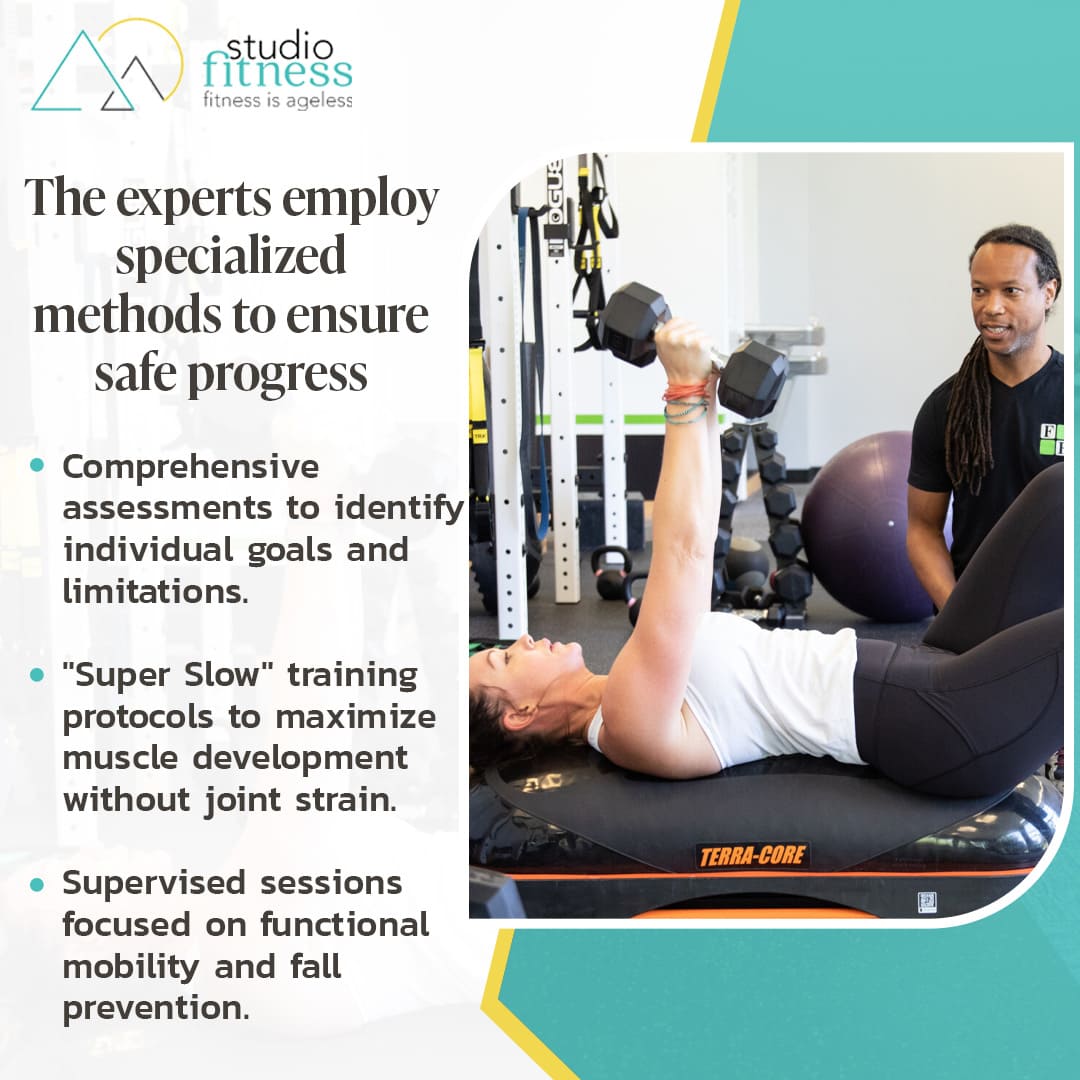
- Slower rep speed – reduces joint stress, increases muscle activation
- Controlled load selection – matched to current capacity, not arbitrary standards
- Longer recovery windows – muscles in older adults need more time to adapt
- Progressive overload at a different pace – gradual increases that don't outpace recovery
Super Slow Strength Training: A Smarter Path for Older Adults
One of the methods used at Studio Fitness is Super Slow strength training – a controlled resistance training protocol that uses very deliberate, slow movement through each repetition. This is the kind of Santa Rosa strength and conditioning that's designed around longevity, not performance benchmarks. This approach reduces momentum and joint impact while increasing time under tension, which is the actual driver of muscle development.
For adults who've been told they “can't” lift weights because of their knees, back, or shoulders, Super Slow training is often the approach that finally makes strength work both accessible and effective.
“The goal isn't to train harder. It's to train smarter – and keep training for decades.”
Common Myths About Resistance Training After 60 – Addressed Directly
A lot of what keeps older adults out of the weight room is based on assumptions that research has since disproven.
“It's too late to start.” Late-onset resistance training produces real results. Adults in their 70s and 80s have shown measurable strength and muscle mass gains from structured programs – often within 8–12 weeks of starting.
“I'll get hurt.” Injury risk in strength training is strongly tied to poor programming: too much load, too fast, without proper progression. A well-designed, individualized program – where movement is assessed and adapted to your history – reduces that risk considerably.
“Cardio is enough.” Cardiovascular exercise supports heart health and endurance. It does not preserve muscle mass, improve bone density, or maintain the strength needed for daily functional movement. Strength training and cardio serve different purposes – both matter, but they are not interchangeable.
“I need a big gym for that.” Large commercial gyms are designed for volume, not personalization. For adults over 50 with specific health considerations, a boutique training environment – where every session is supervised, and every program is built around your body – is typically far safer and more effective.
“Most people who feel too old or too broken to train have simply never had the right program.”
How to Find the Right Personal Training in Santa Rosa for Adults Over 50
When it comes to Santa Rosa personal training, the difference between a good fit and the wrong fit is significant. Not all programs – and not all trainers – are the same. If you're an older adult looking for fitness in Santa Rosa that actually fits where your body is right now, here's what to look for.
What to Look for in a Trainer
What separates effective personal training in Santa Rosa from a generic gym membership comes down to a few non-negotiables:
- Certification as a personal trainer (CFT or equivalent)
- Demonstrated experience working with older adults and injury adaptation
- A clear intake and assessment process before any training begins
- Willingness to modify exercises based on your history and current limitations
- A measured, progressive approach – not a “push through it” mentality
Red Flags to Avoid
- No individualized assessment before your first session
- Group classes with no modification options
- Coaches who don't ask about your injury or health history
- Programs that prioritize intensity over proper form
Why a Boutique Studio Setting Works Better
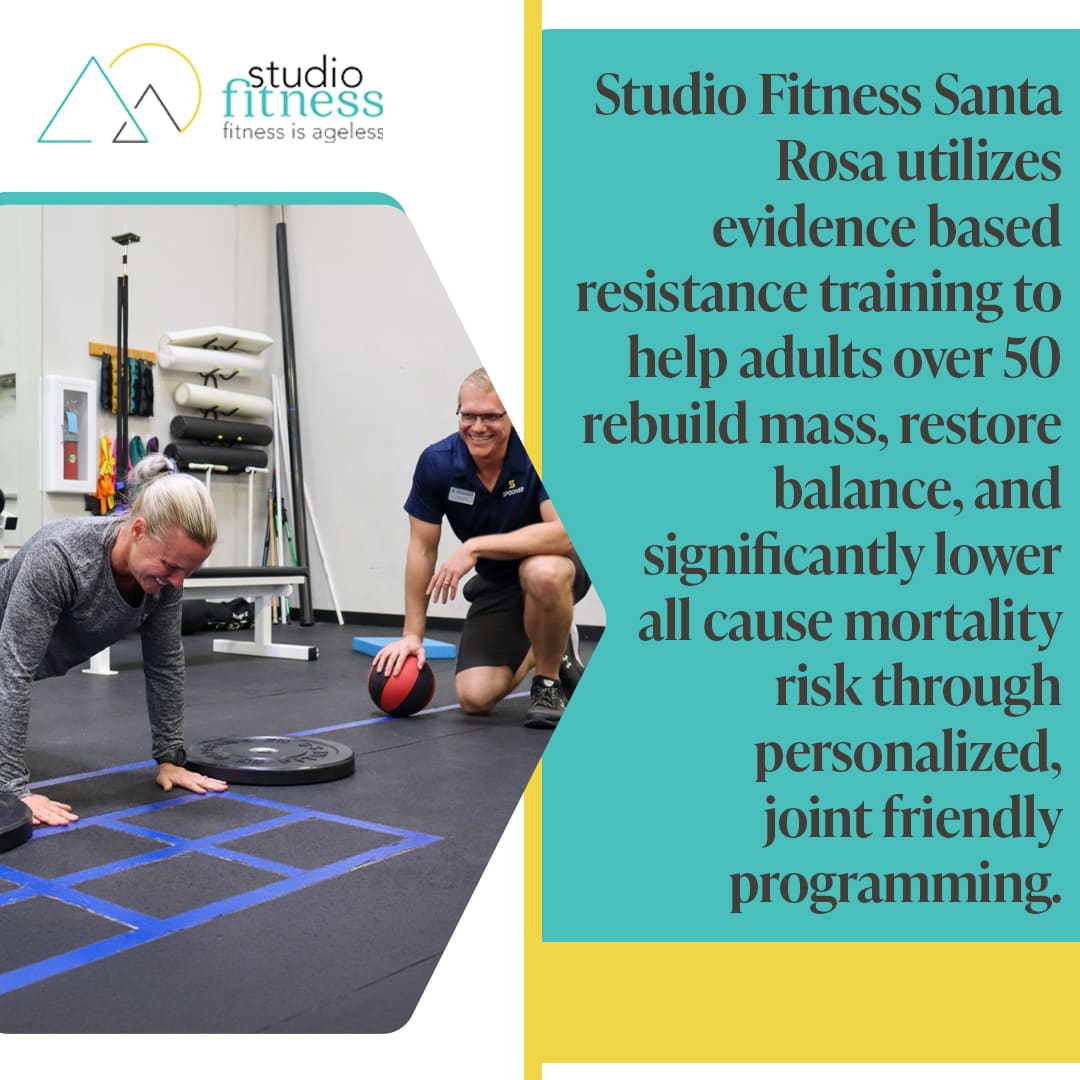
At Studio Fitness, our approach to Santa Rosa strength and conditioning starts with the individual. Every program begins with understanding where you are right now – your history, your limitations, your goals – and builds from there.
That's a fundamentally different experience than what you get at a big-box gym, where you're often on your own to figure out what to do and whether you're doing it safely.
The trainers at Studio Fitness hold CFT credentials and bring decades of combined experience working with adults who want to stay strong, mobile, and independent for life. Learn more about our team on our about page.
You can also explore what a personalized program looks like through our senior fitness services and strength training page.
What to Expect When You Start a Resistance Training Program Later in Life
Starting later doesn't mean starting behind. It means starting where you are – and that's the right place.
The First Few Weeks
Expect mild soreness, especially in muscle groups that haven't been challenged in a while. That's normal. What you should not experience – and what proper programming prevents – is sharp joint pain, extreme fatigue, or the feeling that you've overdone it.
The first weeks are about learning movement patterns, establishing a baseline, and building the foundation that everything else will grow from.
What Progress Looks Like at 60, 70, or Beyond
- Week 1–4: Improved energy, better sleep, minor strength gains
- Month 2–3: Noticeably easier daily tasks – stairs, carrying, getting up and down
- Month 4–6: Measurable strength improvements, better balance, increased confidence
- 6+ months: Meaningful changes in posture, mobility, and functional independence
Why Consistency Beats Intensity – Every Time
The most important variable in long-term results isn't how hard you push in any one session. It's how consistently you show up over months and years. A program you can sustain safely will always outperform one that pushes too hard and causes setbacks.
“Progress after 60 is real. It just looks different – and feels better – than it did at 30.”
Ready to Build Strength That Lasts?
Strength is not something you either have or you've lost for good. It's something that can be built – carefully, safely, and at any age – with the right guidance and the right environment.
At Studio Fitness in Santa Rosa, our certified trainers work with adults in Santa Rosa and throughout Sonoma County who want to stay strong, steady, and capable for years to come. We offer personalized Santa Rosa personal training and a strength training program built around your body – not a generic template – in a calm, boutique setting designed specifically for adults who take their long-term health seriously.
Ready to take the next step? Call us at (707) 235-6426 to schedule a gym tour and fitness evaluation, or contact us to get started.