

The decision between independent training and working with a professional trainer often comes down to understanding what actually drives results. Many adults attempting solo workouts face invisible roadblocks: improper form that creates joint stress, generic programs that don’t address individual limitations, and the absence of progressive planning that prevents plateaus. While some experienced individuals maintain effective routines independently, most people over 45 benefit substantially from professional guidance, particularly when addressing age-related changes in strength, balance, and mobility.
Personal training delivers more than exercise demonstration. A qualified trainer designs customized programs that account for past injuries, current limitations, and realistic goals. They identify movement compensations before they become chronic problems and create accountability structures that transform sporadic effort into consistent progress. For adults in Santa Rosa and Sonoma County seeking sustainable fitness in Santa Rosa approaches, the difference between struggling alone and working with knowledgeable guidance often determines whether someone builds lasting strength or abandons their efforts within months.
Studio Fitness approaches this relationship differently than typical commercial facilities. Rather than pushing generic high-intensity programs, trainers focus on what actually matters for long-term health: controlled movement quality, progressive strength development, and modifications that work with your body instead of against it.
Why Most People Struggle Training on Their Own (And When It Actually Works)
Independent training fails most frequently not from lack of effort, but from the absence of knowledge. Someone performing strength training exercises without proper instruction often reinforces dysfunctional movement patterns. A squat performed with forward knee drift stresses the patellar tendon. A deadlift executed with a rounded lumbar spine loads intervertebral discs incorrectly. These technical errors accumulate over months until minor discomfort becomes a limiting injury.
Common barriers to solo training success include:
- Improper form and technique: Without feedback, people reinforce incorrect movement patterns that stress joints instead of building strength
- Lack of progression planning: Adding weight arbitrarily or performing the same routine indefinitely leads to plateaus or injury
- Motivation gaps: Training consistency drops when life gets busy, and there’s no external accountability
- Information overload: Conflicting advice from online sources creates confusion about what actually works
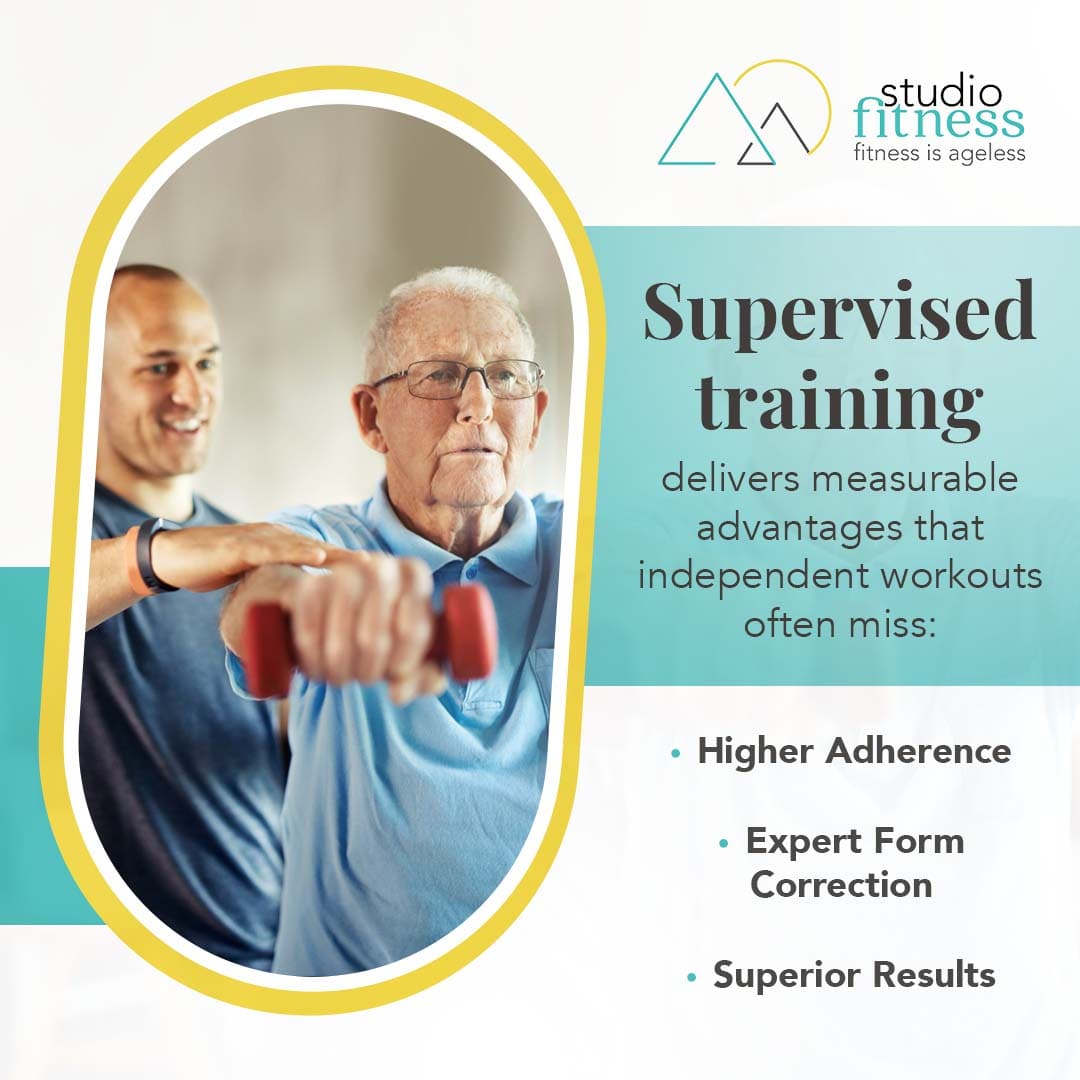
Research suggests that people often show better exercise adherence when training with supervision or trainer support, while independently managed exercise programs may see lower consistency over time.
However, independent training can work effectively when:
- You already possess strong technical knowledge from previous professional coaching
- You’re an experienced lifter maintaining an established program
- You’re following sport-specific protocols designed by a qualified strength coach
- You’re performing simple, low-complexity movements like walking or basic bodyweight exercises
- You’re pain-free and training purely for general health maintenance
The critical distinction: solo training works when someone already possesses technical knowledge, understands progression principles, and maintains intrinsic motivation. For most adults over 45, particularly those dealing with joint discomfort or past injuries, these prerequisites don’t exist.
What Personal Training Actually Provides Beyond Exercise Instruction
Quality personal training in Santa Rosa begins with individual assessment, not generic programming. A thorough evaluation examines movement patterns, identifies mobility restrictions, assesses current strength levels, and discusses injury history. This information shapes a strength training program built around your body’s actual capabilities and limitations, not theoretical ideals.
What professional trainers actually provide:
- Customized program design: Exercises selected based on your specific limitations, injury history, and realistic goals
- Ongoing form correction: Real-time feedback on subtle compensations you can’t see or feel yourself
- Progressive overload planning: Systematic advancement that adapts to your body’s response, not arbitrary timelines
- Accountability structures: Scheduled sessions that create consistency even when motivation wanes
- Safety protocols: Exercise modifications that work around joint pain, arthritis, or past injuries
Form correction represents ongoing value throughout the training relationship. Small technical adjustments – shifting weight distribution during a lunge, controlling descent speed in a squat, maintaining neutral spine position during rows – determine whether strength training exercises build strength safely or create joint stress.
At Studio Fitness, safety protocols matter most for those training with joint pain, arthritis, or past injuries. Our experienced trainers modify exercises to work around limitations while still providing effective stimulus. Someone with shoulder impingement might perform landmine presses instead of traditional overhead pressing. A person with knee osteoarthritis might emphasize eccentric-focused leg training rather than high-impact movements.
The Real-World Difference: What Changes When You Work With a Trainer
Measurable outcomes reveal the practical impact of professional guidance versus independent training. Research comparing supervised to unsupervised training in older adults demonstrates consistent advantages for professionally guided programs across multiple performance measures.
A study published in Gerontology examined 66 older adults (average age 73 years) randomly assigned to supervised training, unsupervised training, or control groups over 12 weeks. The supervised group showed significantly greater improvements in balance performance, stride velocity, functional movement tests, and lower extremity muscle power compared to those training without supervision. The study reported zero training-related injuries across all participants, with attendance rates exceeding 90%.
Research on exercise adherence comparing personal training to minimal supervision found supervised participants maintained 84% adherence to exercise sessions over 24 weeks, compared to just 69% among those with minimal guidance. The study documented that 60% of clients working with personal trainers showed upward movement in their stage of motivational readiness for exercise, with an additional 13% advancing two full stages.
| Outcome Measure* | Independent Training | Professional Guidance |
| Exercise Adherence (24 weeks) | 69% of sessions attended | 84% of sessions attended |
| Balance Performance Improvement | Minimal gains | Significant improvements in multiple tests |
| Functional Movement Tests | Limited progress | Notable advancement in chair stand, timed up-and-go |
| Behavioral Stage Advancement | Lower rates of sustained change | 73% showed upward movement in exercise readiness |
Beyond the numbers, here’s what changes with professional guidance:
- Time efficiency: Accomplish more in 45-60 minutes than 90 minutes of unfocused solo work
- Injury prevention: Catch movement compensations before they become chronic problems
- Confidence building: Discover you can move better than you believed possible
- Functional carryover: Learn movement patterns that improve daily activities outside the gym
- Long-term sustainability: Build habits that last years, not just weeks
Movement pattern correction produces benefits extending beyond the gym. Someone learning proper hip hinge mechanics during deadlifts applies that pattern when lifting objects at home. A person developing single-leg stability during training walks with better balance in daily life.
When Working Out Alone Makes Sense (And When It Becomes Counterproductive)
Independent strength training works effectively for specific scenarios. Experienced lifters maintaining established programs often continue successfully without daily coaching. Athletes following periodized programs designed by coaches can complete prescribed sessions alone between check-ins.
Red flags that indicate you need professional help:
- Chronic pain during or after exercise: Suggests movement dysfunction requiring expert evaluation
- Declining performance despite consistent effort: Indicates improper progression or recovery issues
- Fear of movement: Especially after past injuries—needs professional guidance to rebuild confidence safely
- Plateaus lasting more than 4-6 weeks: A sign that your program lacks proper progression planning
- Uncertainty about form: If you’re not confident in your technique, you’re likely reinforcing poor patterns
The “YouTube University” approach – learning exercises from online videos – creates false confidence in technical competency. Watching demonstrations doesn’t provide the proprioceptive awareness needed to execute movements correctly. Video instruction lacks the corrective feedback needed for safe, effective training.
How to Evaluate If Personal Training Is the Right Investment for Your Goals
Self-assessment begins with an honest evaluation of current fitness knowledge and movement competency. Ask yourself: Can I demonstrate proper form for fundamental movement patterns? Do I understand how to progress exercises safely over time? Can I identify when a technical breakdown occurs during training? Most adults answer “no” to these questions, indicating professional guidance would benefit their training.
Personal training makes the most sense when:
- You’re focused on longevity and maintaining independence as you age
- You’re dealing with joint pain, past injuries, or movement limitations
- You want to build strength, but fear getting hurt
- You’ve tried gym memberships before without seeing results
- You need accountability to maintain consistency
- You’re overwhelmed by conflicting fitness advice
Understanding what quality fitness in Santa Rosa looks like helps with evaluation. Effective trainers perform thorough initial assessments before prescribing exercises. They ask detailed questions about injury history, daily activities, and specific limitations. They demonstrate exercises clearly and watch your execution closely, providing specific corrections rather than generic encouragement.
Red flags in trainers to avoid:
- Using identical programs for different clients regardless of individual needs
- Ignoring pain or discomfort during exercise
- Pushing intensity without establishing movement quality first
- Lacking certifications or continuing education
- Creating competitive or intimidating environments
- Making unrealistic promises about rapid transformation
Quality trainers modify exercises based on individual response and communicate clearly about programming decisions. This personalized approach is exactly what Studio Fitness prioritizes: matching each client with trainers who understand how to adapt a strength training program for individual needs rather than forcing everyone into the same template.
The Boutique Studio Difference: Why Training Environment Matters as Much as the Trainer
The physical environment influences training outcomes more than most people recognize. Crowded commercial facilities with loud music, complicated equipment, and predominantly younger populations create anxiety for many adults over 45. The training environment either supports your success or undermines it, regardless of programming quality.
Why boutique studio environments produce better outcomes:
- Calm, professional atmosphere: Reduces anxiety and allows focus on movement quality
- Personalized attention: More one-on-one time means better observation and form corrections
- Supportive community: Train alongside people with similar goals without competitive pressure
- Long-term relationships: Trainers develop a deep understanding of how your body responds over time
- Age-appropriate focus: Programming designed for adults 45-75, not younger populations
Long-term client relationships that adapt as bodies change deliver compounding value over time. A personal trainer in Santa Rosa who works with you for months or years develops a deep understanding of how your body responds to different training stimuli, which exercises work best for your structure, and how to modify programming during periods of increased life stress or minor setbacks.
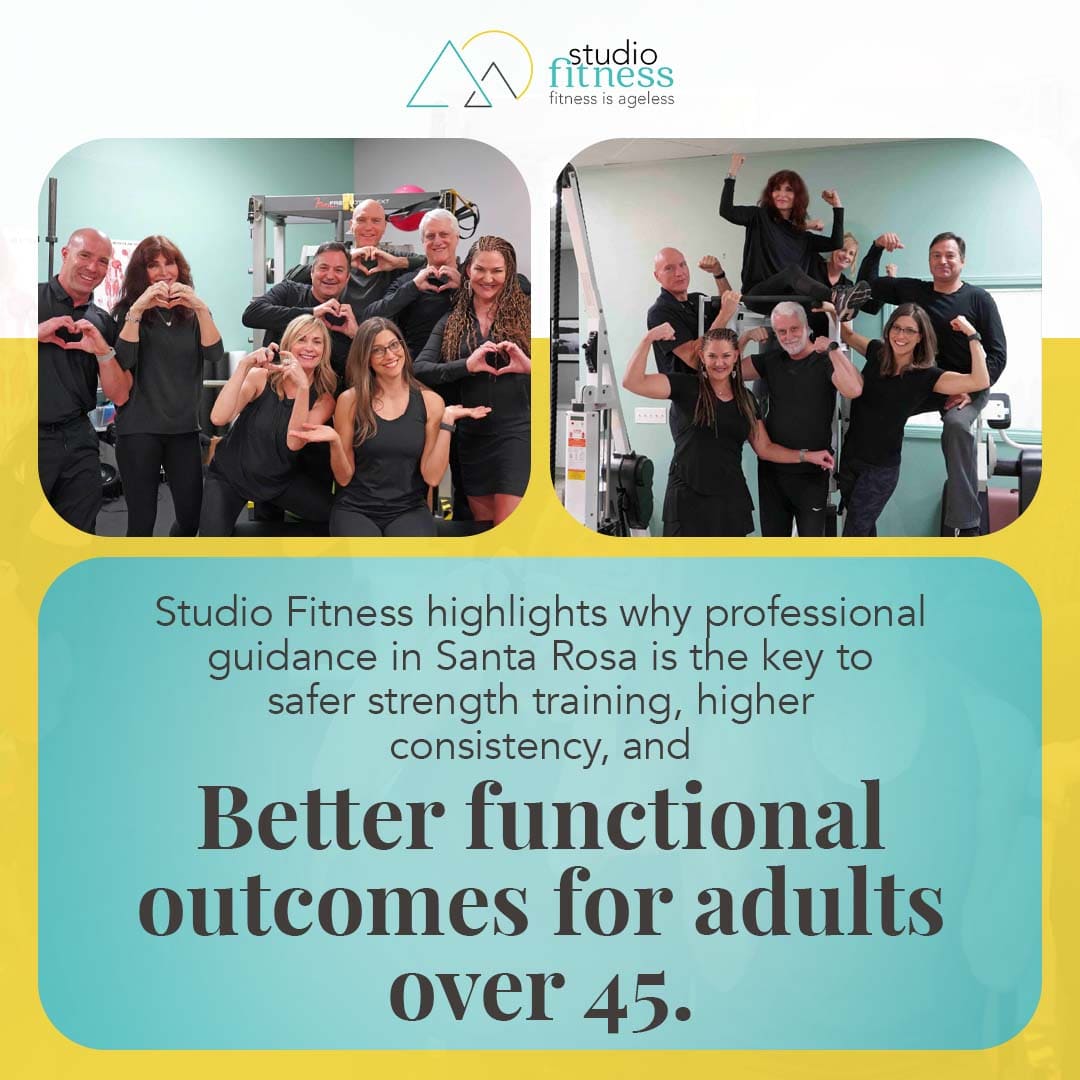
Studio Fitness builds training relationships around these principles specifically because we work primarily with adults 45-75 who need intelligent, patient, individualized guidance. Rather than applying aggressive programs designed for younger populations, we focus on controlled movement quality, progressive strength development appropriate for aging bodies, and creating calm training environments where people feel comfortable learning and improving.
Take the Next Step Toward Stronger, More Confident Movement
Professional guidance transforms exercise from an uncertain solo effort into systematic strength development. The difference appears not just in better results, but in reduced injury risk, improved confidence, and sustainable long-term adherence. While independent training works for some, most adults over 45 benefit substantially from working with knowledgeable trainers who understand how to build strength safely while respecting current limitations.
Studio Fitness specializes in exactly this type of intelligent, personalized training. We work with adults throughout Santa Rosa and Sonoma County who want to build lasting strength, maintain independence, and move confidently without fear of injury. Our trainers design programs around your actual body and realistic goals, not generic templates that ignore individual needs.
Ready to experience what professional guidance can do for your strength and mobility? Call us at (707) 235-6426 or email shelly@studiofitnesssantarosa.com to schedule a gym tour and fitness evaluation. We’ll assess your current movement patterns, discuss your specific goals and concerns, and show you how personalized training differs from working out alone. You can also visit our contact page to learn more about our approach and get started with a program designed specifically for you.