

Strength training exercises do more than build muscle. They create a protective framework around your joints, bones, and connective tissues that helps prevent injuries during everyday activities. When you bend down to tie your shoes, reach overhead to grab something from a shelf, or walk across an uneven surface, your muscles act as shock absorbers and stabilizers that keep you safe. Without adequate strength, these simple movements can lead to strains, sprains, and more serious injuries.
A well-designed strength training program addresses the muscle imbalances and weaknesses that make injuries more likely. Research shows that adults who maintain regular resistance training reduce their injury risk by 30-40% compared to those who remain sedentary. This protection extends beyond the gym. It shows up when you're carrying groceries, working in the garden, or simply getting in and out of your car without pain or hesitation.
In Santa Rosa and Sonoma County, adults who invest in structured strength and conditioning work with qualified trainers experience fewer limitations in daily life. They move with more confidence, recover faster from physical demands, and maintain their independence longer. At Studio Fitness, we focus on building this kind of protective strength through personalized programming that addresses your specific needs, movement patterns, and physical history. The goal isn't just stronger muscles. It's a body that supports you reliably in everything you do.
Why Your Body Needs Protective Strength to Move Safely Every Day
Your muscles do more than generate force. They stabilize joints, absorb impact, and control movement in ways that prevent injury during routine activities. When these muscles are weak or imbalanced, your risk of getting hurt increases dramatically.
Consider what happens when you step off a curb unexpectedly. Your ankle muscles must react instantly to prevent rolling. Your knee stabilizers keep the joint aligned. Your hip muscles control your balance. If any of these muscle groups lack strength, the result can be a sprain, strain, or fall.
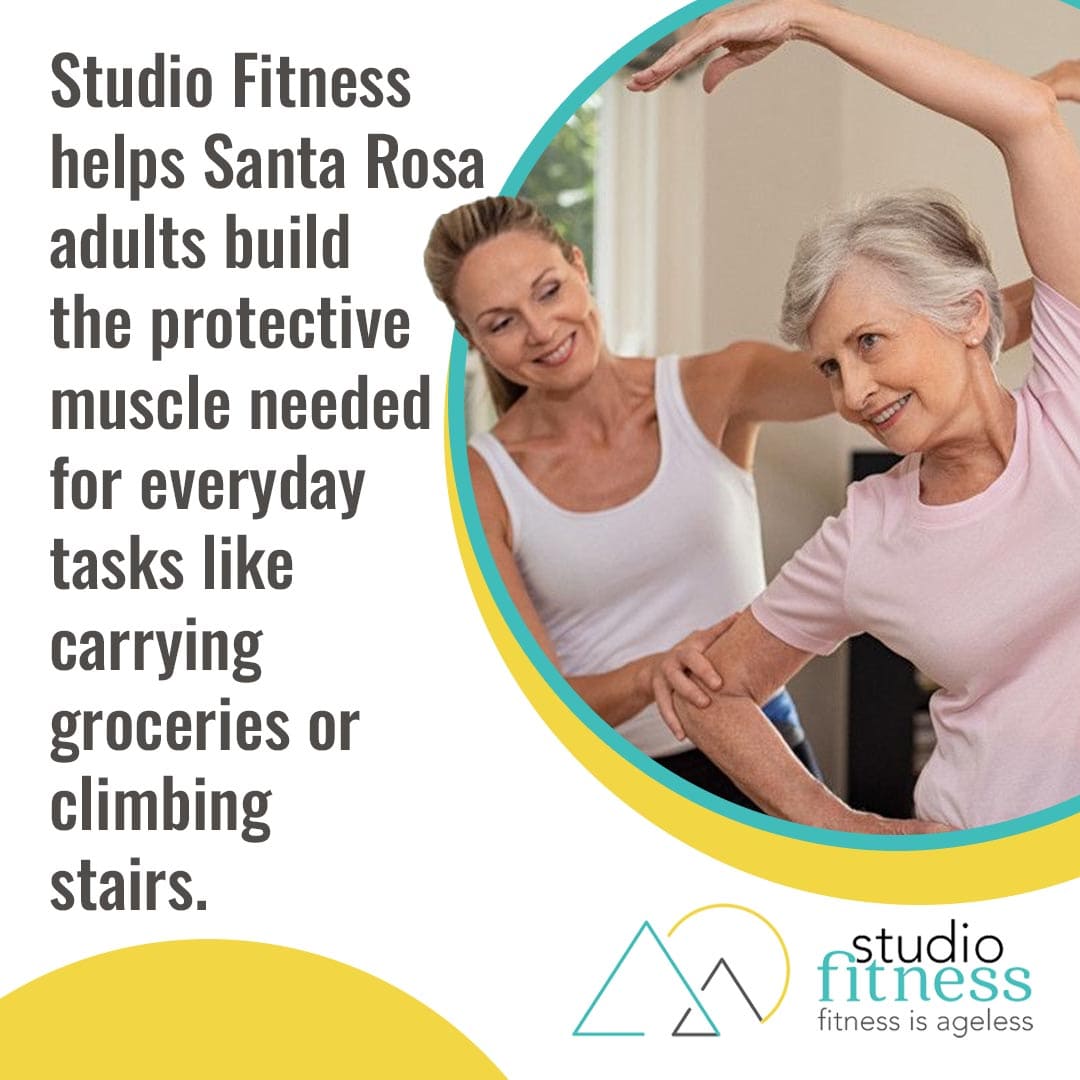
Common daily movements rely on protective muscle strength:
| Daily Activity | Primary Protective Muscles | Injury Risk When Weak |
| Walking on uneven ground | Ankle stabilizers, hip abductors | Ankle sprains, falls |
| Carrying groceries | Core muscles, shoulder stabilizers | Lower back strain, shoulder impingement |
| Getting out of car | Hip flexors, quadriceps, core | Hip pain, back strain |
| Reaching overhead | Rotator cuff, scapular stabilizers | Shoulder injury, neck strain |
| Bending to pick up objects | Hamstrings, glutes, spinal erectors | Lower back injury, muscle pulls |
| Climbing stairs | Quadriceps, glutes, ankle stabilizers | Knee pain, falls |
The Centers for Disease Control and Prevention reports that more than one out of four older adults falls each year, with falls being the leading cause of injury death for adults 65 and older. Many of these falls result from insufficient leg strength and poor balance control, both of which respond well to resistance training.
Strength training exercises target these protective muscle groups systematically. When you squat, you strengthen the muscles that control your knees and hips during everyday bending. When you perform rows, you build the upper back muscles that prevent shoulder injuries when reaching. Each exercise prepares your body for real-world demands.
The protective effect compounds over time. Stronger muscles mean better joint alignment, reduced wear on cartilage, and faster reflexive responses when you need to catch yourself or adjust your movement. This protection operates constantly, whether you're aware of it or not.
How a Structured Strength Training Program Builds Injury Resistance
Random workouts don't create the same protective benefits as a thoughtfully designed strength training program. Structure matters because injury prevention requires consistent, progressive development of all muscle groups, not just the ones you prefer to train.
A proper program includes these elements:
- Progressive Overload: Your muscles adapt to increased demands by getting stronger. A structured program gradually increases resistance, volume, or difficulty in controlled increments. This builds capacity without overwhelming your tissues and triggering injury.
- Balanced Development: Many people naturally develop strength imbalances. Right-handed individuals often have stronger right sides. Desk workers typically have weak posterior chains. A good program identifies and corrects these imbalances before they cause problems.
- Movement Pattern Training: Rather than isolating individual muscles, quality programs teach your body to move efficiently through fundamental patterns: squatting, hinging, pushing, pulling, and rotating. These patterns mirror real-life movements and train multiple muscle groups to work together protectively.
- Controlled Tempo: Slow, controlled movements during strength training exercises teach your nervous system to maintain tension and stability throughout a full range of motion. This control transfers directly to daily activities where unexpected movements occur.
Personal training provides the structure many people need to build this protective strength safely. A qualified trainer identifies your weak points, designs progressive programming around your goals, and adjusts the plan based on how your body responds. This personalized approach reduces trial-and-error while accelerating results.
The Science Behind Strength Training and Connective Tissue Health
Muscles get attention in strength training discussions, but connective tissues–tendons, ligaments, and bones–benefit just as much. These structures adapt to mechanical stress by becoming denser and more resilient, which directly reduces injury risk.
When you perform resistance exercises, you create controlled stress on your tendons and ligaments. These connective tissues respond by laying down additional collagen fibers and increasing their thickness. The result is stronger, more injury-resistant tissue that can handle sudden forces without tearing.
Bone responds similarly. Weight-bearing strength training exercises stimulate bone cells to deposit more minerals, increasing bone density. This is particularly important for adults over 50, when bone loss accelerates and fracture risk increases.
| Tissue Type | Adaptation to Strength Training | Timeframe for Changes | Injury Prevention Benefit |
| Tendons | Increased collagen density, improved elasticity | 12-16 weeks | Reduced tendinitis, less rupture risk |
| Ligaments | Enhanced cross-linking, greater tensile strength | 12-20 weeks | Better joint stability, fewer sprains |
| Bone | Increased mineral density, improved architecture | 16-24 weeks | Reduced fracture risk, better impact absorption |
| Cartilage | Improved fluid dynamics, enhanced nutrition | 8-12 weeks | Slowed degeneration, reduced joint pain |
A systematic review and meta-analysis examining resistance training in older adults found that protocols involving progressive resistance training were effective for improving bone mineral density at the femoral neck, total hip, and lumbar spine–areas particularly vulnerable to fracture.
These adaptations take time. You won't develop significantly stronger tendons in a few weeks. But consistent training over months creates cumulative improvements that protect you for years.
Age matters here. Adults in their 40s, 50s, and 60s experience natural declines in connective tissue strength and bone density. Strength training doesn't just slow this decline. It can reverse it, restoring tissue quality that may have diminished over previous inactive years.
The protective benefit extends beyond preventing acute injuries. Stronger connective tissues and denser bones resist the chronic wear-and-tear that leads to arthritis, degenerative disc disease, and other age-related conditions that limit mobility and independence.
What Proper Form and Technique Mean for Long-Term Injury Prevention
Lifting weights with poor form creates the injuries that strength training should prevent. Proper technique isn't about perfectionism. It's about positioning your body so forces distribute correctly across joints and muscles, protecting vulnerable structures while developing strength.
Common form mistakes that lead to injury include:
- Rounding the spine during deadlifts or rows: This places excessive stress on intervertebral discs and spinal ligaments, leading to back injuries that can persist for months or years.
- Letting knees collapse inward during squats: This misalignment strains the knee joint and surrounding connective tissues, increasing the risk of meniscus tears and ligament damage.
- Hyperextending the lower back during overhead presses: This compresses the lumbar spine and can trigger acute back pain or chronic instability.
- Allowing shoulders to roll forward during pushing movements: This position pinches the rotator cuff tendons, causing shoulder impingement that limits overhead movement.
The problem with poor form is that it often feels fine initially. You can perform exercises incorrectly for weeks or months before the accumulated stress triggers an injury. By then, you've developed faulty movement patterns that require time and effort to correct.
Professional coaching addresses this problem. A knowledgeable trainer watches how you move, identifies compensations and alignment issues, and provides immediate feedback that corrects technique before it becomes habitual. This is one of the primary values of personal training in Santa Rosa–having someone who can see what you can't feel.
Proper form also changes the training stimulus. When you perform an exercise correctly, the target muscles work harder while supporting structures stay safe. You build more strength with less weight, reducing injury risk while improving results.
Video analysis helps. Many people are surprised when they see themselves performing an exercise. What feels like a neutral spine might show significant rounding. What seems like good depth in a squat might reveal a limited range of motion. Seeing the movement from outside provides information your body can't sense internally.
Form requirements also change as you age. A movement pattern that worked fine at 30 might need adjustment at 55 due to reduced flexibility, previous injuries, or postural changes. Quality coaching adapts technique recommendations to your current physical state rather than applying generic standards.
Building Functional Strength That Transfers to Real Life
Functional strength means your body can handle the physical demands of daily living without struggle or injury risk. This differs from the strength that only shows up in the gym. The goal is movement competence that makes life easier and safer.
Traditional bodybuilding approaches often isolate individual muscles, which can build an impressive appearance without proportional real-world capability. Functional training emphasizes movement patterns that combine multiple muscle groups working together, exactly as they do during everyday activities.
Key functional movement patterns include:
- Squatting: Sitting down, standing up, picking objects off the floor, getting in and out of vehicles. A solid squat pattern protects your knees and back during countless daily movements.
- Hinging: Bending forward at the hips while maintaining a neutral spine. This pattern appears when you lean over a sink, pick up a laundry basket, or work in the garden. Proper hinging mechanics prevent the back injuries that plague adults who bend incorrectly.
- Pushing: Opening heavy doors, placing items on high shelves, getting up from the floor. Horizontal and vertical pushing strength supports dozens of upper-body tasks.
- Pulling: Carrying groceries, opening stuck drawers, helping yourself up from a seated position. Pull strength balances push strength and prevents the forward-rounded posture that limits movement.
- Rotating: Turning to reach behind you, throwing, or swinging a golf club. Rotational strength with core stability prevents the spine injuries that occur during twisting movements.
- Balancing: Walking on uneven surfaces, catching yourself when you trip, and moving confidently in challenging environments. Balance training reduces fall risk and builds movement confidence.
A quality strength training program incorporates all these patterns, not just the exercises you prefer. This creates comprehensive capability rather than isolated strength in a few movements.
The transfer to daily life happens naturally. When you've trained your body to hinge properly with weight, you automatically use better mechanics when bending to tie your shoes. When you've developed pushing strength, placing heavy items on high shelves becomes easier and safer. The movement competence you build in training protects you constantly.
This is where personalized programming shows its value. Your daily life has specific physical demands that generic programs can't address. If you garden regularly, your strength training program should include movements that prepare you for the bending, lifting, and kneeling that gardening requires. If you travel frequently, your program should build the endurance and stability that make navigating airports and carrying luggage less stressful.
At Studio Fitness, we design strength training programs around what matters to you. The exercises we choose aren't just about building muscle. They're about making your life physically easier and reducing the worry that everyday movements might trigger injury or pain.
When to Seek Professional Guidance for Safe Strength Training
Knowing when you need professional help with strength training can prevent months of frustration and potential injury. Several signs indicate that working with a qualified trainer would benefit you more than attempting to figure things out alone.
- You have existing pain or injuries: Training around limitations requires knowledge and experience. A skilled trainer can design programming that works around your restrictions while gradually improving the underlying issues. Attempting this alone often makes problems worse.
- You've had previous training injuries: Past injuries during exercise suggest form issues, programming errors, or movement compensations that need correction. Repeating the same approaches will likely produce the same results. Professional guidance identifies and fixes these problems.
- You feel confused about where to start: The volume of conflicting fitness information available online can be paralyzing. A trainer cuts through the noise and provides a clear, personalized starting point based on your current capabilities and goals.
- You've trained inconsistently with poor results: Lack of results usually stems from programming problems, not lack of effort. Poor exercise selection, incorrect volume, inadequate recovery, or missing progressive overload can all prevent progress. A knowledgeable trainer identifies and corrects these issues quickly.
- You're experiencing age-related changes: If you're noticing decreased strength, flexibility, or balance as you get older, professional guidance helps you address these changes safely and effectively. Generic programs don't account for the specific needs of adults in their 50s, 60s, and beyond.
What to expect from quality Santa Rosa strength and conditioning programs:
- Initial assessment: Evaluation of your current movement patterns, strength levels, and any limitations or concerns
- Personalized programming: Exercise selection and progression designed specifically for your goals and physical state
- Form coaching: Detailed instruction on proper technique with regular feedback and adjustments
- Progressive planning: Systematic advancement that builds strength safely without overwhelming your body's capacity to adapt
- Ongoing adjustments: Regular program modifications based on your progress, response, and changing needs
Questions to ask when choosing training support:
- What certifications and experience do you have working with people similar to me?
- How do you modify exercises for previous injuries or current limitations?
- What does a typical training session include?
- How do you track progress and adjust programming?
- What happens if I experience pain or discomfort during an exercise?
The difference between corporate gyms and boutique studios like Studio Fitness often comes down to attention and expertise. Large facilities may offer lower prices but provide minimal individualized coaching. Boutique environments prioritize personalized programming and ongoing guidance, which matters considerably when you're trying to build strength safely and effectively.
Professional strength and conditioning guidance isn't just for athletes or people with serious injuries. It's for anyone who wants to build protective strength efficiently while minimizing their risk of setbacks. The investment in quality coaching typically pays for itself through faster progress and avoided injuries.
Start Building Protective Strength in Santa Rosa
Building strength that protects you during daily activities doesn't require complicated equipment or extreme workouts. It requires consistent, properly designed training that addresses your specific needs and physical history. This is exactly what we provide at Studio Fitness. Our strength and conditioning programs are tailored to help adults improve stability, mobility, and overall physical resilience in a safe, structured setting.
Our boutique training environment focuses on adults who want to stay strong, mobile, and independent as they age. We work with people who have joint concerns, past injuries, or simply want professional guidance to train safely and effectively. Our experienced trainers design personalized programs that build the protective strength your body needs without the intimidation or confusion that often comes with traditional gym environments.
We serve Santa Rosa and Sonoma County residents who value quality coaching and a calm, supportive training atmosphere. If you're ready to invest in strength that supports your daily life and reduces your injury risk, we can help.
Call (707) 235-6426 or email shelly@studiofitnesssantarosa.com to schedule a gym tour and fitness evaluation. During your visit, we'll discuss your goals, assess your current movement patterns, and explain how our approach can help you build the protective strength you need. You can also contact us through our website to learn more about our personal training programs and schedule your visit.
Your body deserves the protection that proper strength training provides. Let's build it together.